


Why Nature Belongs at the Heart of Care
Updated: Feb 26
Nature is not a place to visit. It is home.
–Gary Snyder
We are living through turbulent times, and in the midst of so much uncertainty, what steadies us? For me, again and again, the answer is connecting with Nature, with my wider ecological self, with the flora, fauna, soil, sky, and waters. With Home.
Last weekend, while traveling through the Pacific Northwest, our little Jack Chi, Bizkit, suddenly fell ill. We spent the night in an emergency animal hospital—record-breaking heat, bright lights, highway noise, and pavement all around us.
When I stepped outside with him, he looked up at me as if asking,
“Where is the grass?”
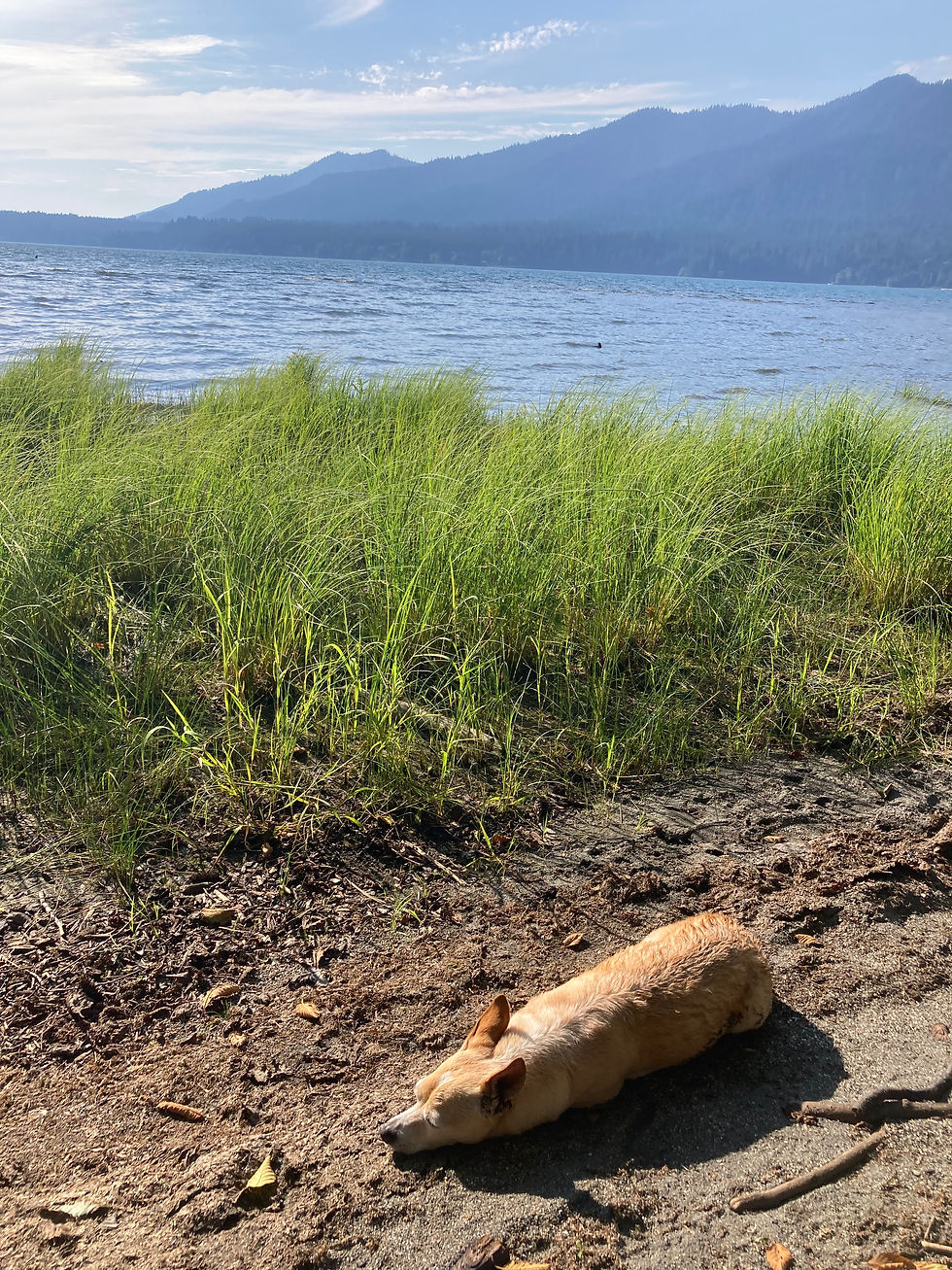
Once Bizkit began to recover, we returned to the tranquil calm of Lake Quinault, nestled among the giants of rainforest village. The moment his paws touched the sand, he stretched out by the water. My heart finally eased, as it was the first time in days he seemed to be improving, returning to his joyful, vibrant self.
As you can see in the photo, his body, mind, and spirit soaked in the healing energy of Nature: grounded in the sand, soothed by the glacier-fed waters, surrounded by the song of trees and birds. He was home again.
This experience reminded me never to take for granted the gift of wild natural places, swimming in a clean lake, gently walking among giant cedars and spruce trees, or simply sharing care outdoors to help a loved one heal. I too began to calm, remembering that my best friend and I share a reciprocal relationship of care. When he is unwell and can’t tell me what’s wrong, it is deeply distressing.

The next day, with Bizkit stronger, we walked the Rainforest Nature Trail, chasing waterfalls.
Along the way we met a couple reflecting on how the path, though marked “accessible,” was far too narrow for an all-terrain wheelchair or safe use with a walker.
They wanted to bring their mother, who loves being deep in Nature, but worried it wouldn’t be possible. We spoke about Care Outdoors, and together we imagined something different:
What if care communities were designed like actual parks, where the Great Outdoors was a natural extension of daily life?
Picture arriving to visit your mom and hearing, not that she’s in her room, but: She’s down by the lake.
They both smiled, “That would be amazing!”
That vision, of care communities, cares, residents, staff, all people, rooted in Nature, is at the heart of Care Outdoors Continuing Education.
Since August 1st, I’ve been on the road, while preparing for the upcoming seminar course Eco Gerontology: Aging in Harmony with Nature. The adventure has been both nurturing and anxiety-filled. I tune into journalists I trust to stay informed, and I won’t pretend the realities we’re facing aren’t overwhelming.
You can read about import taxes driving up essential goods, the rise of older adults experiencing homelessness for the first time, food banks struggling to serve four times more people, the billionaire class amassing unchecked wealth,
and the accelerating climate crisis.
A sustainable society is one that satisfies its need without jeopardizing the prospects of future generations. – Lester Brown, Earth Policy Institute

But when you witness it in every small town, every landscape, when you see food insecurity, shuttered resources, unraveling of social fabrics, and climate impacts firsthand, you realize these challenges are not some distant future.
They are here.
And yet, my ability not to collapse under the weight of it all,
my ability to still imagine a livable, sustainable future,
is wholly tied to my connection with Nature, with Home.
Each time I go outdoors, become aware of my breath, feel the earth and look up into the sky, my body responds.
Dopamine, serotonin, endorphins, oxytocin; happy brain chemicals begin to flow. I feel a love greater than myself, a sense of belonging, and the deep knowing that I am Home.
Connecting with Nature heals. Growing and sharing food heals. Breathing with the trees, listening to the sacred waters, gazing into the stars, these simple, timeless acts connect us to the heart of who we really are.
In a world of AI, big tech, and constant distraction, the one source of knowledge and care we can fully trust is Nature. She nurtures, she steadies, and she calls us Home.
Thank You for being here.

Why Does Nature Belong at the Heart of Care?
A recent study from Finland, a nation where friluftsliv (open-air life) and Everyman's Rights are embedded into daily culture, offers profound insight into the importance of Nature for older adults.
Researchers surveyed 854 assisted living residents, average age 83, more than half living with dementia.
Their findings cut straight to the heart of what matters in later life:
96% said Nature was important to them.
Only half were able to access Nature as often as they wished.
Just 24% could independently go outdoors.
More than half experienced loneliness, and nearly half reported depression.
Responses, in the words of the residents, to the open question exploring the importance and meaning of Nature:
I have missed nature; I wish it was summertime so that I could be sitting there.
I have spent a lot of time in nature, now I experience more of a sense of sacredness, nature has enormous importance.
I used to go picking mushrooms and berries and now I cannot do that anymore, I miss that.
Responses to the open question
“What kind of nature experiences do you wish for?”
To sit in the yard and smell the scents, listen.
Getting outdoors!
Experiences of moving around in nature.
Important Places in Nature:
At the cottage, and sauna and water.
To go to Lapland in the autumn season, berry picking.
Into the forest to listen to the bird singing.
Primeval, old forest.
Let’s go to the lake, have a campfire and go fishing, catch some perch.
If I could go swimming in the lake.
Importantly, the study also highlighted how the everyday experience of nature shaped identity and resilience.
Clear themes emerged:
Nature supports peace of mind, relaxation, physical activity, connection, and identity.
Yet physical and organizational barriers limit daily access.
For many residents living with dementia, the possibility of going outside depended entirely on whether staff believed in the value of Nature and facilitated it.
Staff attitudes, in other words, determine whether connecting with Nature is treated as a luxury or a necessity, a common theme in multiple studies.
Unlike Finland, here in the U.S., we lack a cultural foundation of “every person’s right to Nature.”
Most assisted living and nursing home residents, and their cares, spend the majority of their days indoors without connection to the living world. Gardens, patios, or walking paths may exist, but they often lack ecological diversity, variety of plants, trees, birds, and flowers, and are rarely integrated into daily care.
Landscapes that promote wellbeing benefit residents, staff, families, and whole communities. Despite research, case studies, and recommendations, placing Nature at the heart of design and care is still rare.

Can we nurture our nation with wellness initiatives that fully integrate the healing power of trees, birdsong, sunlight, and fresh air into daily life?
As the Finnish study highlights:
"Accessible natural surroundings promote physical and social activity, supporting emotional, physiological, and cognitive capacities, and resilience, while natural vegetation reduces harmful exposure, such as pollution or extreme temperature.
Living close to greenspace, i.e., parks and forests, is associated with a reduction in all-cause mortality, particularly among older adults with chronic diseases."

I have a collection of quotes from friends and neighbors in residential care:
One friend, age 83, living in an independent senior living community:
"They don’t want us to connect with Nature. Look at those paths, there is nothing, no life where we can access. I want to go camping, be back in wild Nature."
Another, “Lucille,” age 77, in the same community:
"I want to find a tree to befriend and just sit there alone and be with the tree. Nature is my spirituality."
Imagine if you could no longer swim in a lake, sit by a campfire, walk in an ancient forest, or simply enjoy the tranquility of being outdoors.
The quiet, restorative presence of Nature is invaluable.
We don’t need more data to act. We can begin now.

Reimagining elder care, and all care, is about thriving through connection: with the natural world, our shared home, and the living environment that sustains us all.
Every person, regardless of age or ability, should have daily access to the outdoors: fresh air, sunlight, the open sky, birdsong, and the healing presence of Nature.
There is no reason anyone should be confined indoors.
Indoor plants, virtual reality, or other substitutes cannot replace the real experience of going outside and feeling the ground beneath your feet and the sky above your head.

Staff training can frame the Nature Experience and the Great Outdoors as essential to care, and policies can treat access to sunlight and fresh air as a right, not a privilege.
Care Experiences that connect people to HOME.
If you are still unsure why radically transforming care is urgent, watch Susie Singer Carter’s documentary No Country for Old People.

For anyone unfamiliar with our high-cost, profit-over-people system, this documentary is eye-opening and as you watch, you will witness residents and carers largely locked indoors with minimal access to fresh air, sunlight, birdsong, the wider world beyond the walls.
How have we as a society normalized this?
Some suggest bringing nature indoors or using virtual reality for those who cannot go outside.
These interventions can supplement, but never replace, the health benefits of being outdoors in wild, natural places.
VR does not produce Fresh Air.
Consider the current state of U.S. Care Facilities:
Nearly 42% of all COVID-related deaths occurred in nursing homes and assisted living facilities.
72% of nursing homes and over 80% of assisted living and memory care facilities are for-profit.
Less than 25% are nonprofit, and 7.2% are government-owned.
Private equity firms own 11%+ of nursing homes, with numbers rising.
Nearly 60% of nursing homes belong to corporate chains.
Quality Outcomes:
For-profit facilities historically show lower quality outcomes.
Private equity-owned homes often have lower staffing, poorer resident outcomes, and more deficiencies.
A survey by the John A. Hartford Foundation of over 1,000 older adults found:
71% are unwilling to live in a nursing home in the future.
Nearly 90% say major changes are needed to make nursing homes even remotely appealing.
Nursing Home Costs are Rising Rapidly:
In 2016, the average annual cost was $82,000 for a semi-private room and $92,000 for a private room. By 2030, these costs are projected to reach $125,000 and $142,000.
By 2029, an estimated 7.8 million older adults (54%) may not qualify for Medicaid even after spending down assets.
Rapid Population Aging in a Climate-Changing World:
By 2030, one in four Americans will be 65 or older; the 85+ age group will grow from 6.5 million to 11.8 million by 2035 and 19 million by 2060.
Fewer family caregivers due to declining marriage and fertility rates, even as life expectancy increases.
Climate change threatens facilities with severe weather events.
Systemic issues: disjointed care, variable oversight, and fragmented funding streams make quality improvement difficult.

Can you imagine what care communities of the future would look and feel like if integrating the Nature Experience was at the heart of our designs?
With so much evidence on nature’s role in health and wellbeing, we can co-create healing places where elders and staff alike are immersed daily in reciprocal shared care with birdsong, tree canopy, nutrient-rich food producing gardens, natural light. Person-centered care that goes beyond activities, care that nurtures our wider community, meaning, value, and opportunities to make meaningful contributions to our world.
Nature connection is not a luxury; it is a basic human need that remains vital until our very last breath. Research shows people’s connection to nature has declined by more than 60% since 1800, yet evidence continues to link nature connectedness with wellbeing and pro-nature behaviors.
As our population ages amid climate change, resilience and adaptability become essential. Older adults are both vulnerable to ecological disruption and vital contributors to restoring our relationship with the living world.
Whether in Helsinki or the U.S., older adults find identity, peace, and belonging through connection with Nature. The difference lies in whether our care systems allow it.
"Eco-distress has mostly been described in younger populations. However, our results show that also older adults experience ecological grief, such as concern of loss of biodiversity, natural surroundings, and climate change.
The inhabitants in assisted living facilities valued nature even higher than the general population, as in a recent population survey in Finland, 87% answered that nature was important in their current life. Women older than 65 years reported the highest appreciation of nature in this online-survey.
The high prevalence of loneliness and depressive symptoms supports the need for interventions alleviating these experiences. Loneliness, depression, cognitive decline, and poor functional ability often coexist.
Interventions building on connections with natural elements potentially improve wellbeing, and the high interest to participate in NBIs supports future development of such interventions. Considering the aging society and the carrying capacity of health care, the need for effective health interventions is immense."

The Call to Action:
It is time to reclaim what has always been ours: our innate ability to care, for each other, in, with, and for Nature.
Together, we can weave the old with the new, honoring each other and all living beings that make life possible.
Imagine care designed by the people, for the people, and for all living beings on Earth,
Our Shared Home 🌍
Let us choose life over corporate greed, private equity, and REITs.
Let us grow care rooted in love, community, and Nature.
We Are All Connected.
Together we can innovative systems of care that help us adapt to a Climate-Changing world while weaving ancient ecological wisdom into a new way of being with care and living, ensuring a sustainable future for all.
Meaningful change happens through education, experience, and shared action.
If you are ready to be part of this transformation, in invite you to explore Care Outdoors Continuing Education offerings, join our growing community, learn and practice simple yet profound evidence-based ways to share care outdoors.
Together, we can shape the future of care and living where every person, every being on our shared home can thrive.
Enjoy a few moments, feel your feet rooted in the sand, and breathe deep. Imagine what IS possible when we connect with Home. After, I inspire you to go outdoors, become aware of your breath, and feel your feet firmly rooted on the Earth and look up into the sky.

Ready to integrate a new lens into our Aging frameworks?
Join the first ever experiential seminar-style course on Eco Gerontology, your participation will help grow and shape the future of the field, ensuring current and future generations can enjoy harmonious longevity.
We will explore our ecological selves and healing our relationship with home.
Learn More and Join Us:
NCCAP Approved for 16 CEUs!
Approval #: NCCAP535062-26NT
Why does this matter?
✅ Meets national certification standards
✅ Assures quality, relevance, and credibility
✅ Offers a trusted, evidence-based learning experience
✅ Empowers care professionals to lead with Nature Connectedness

Research:
Kolster, A., Rautiainen, L. J., Aalto, U. L., Jansson, A., Partonen, T., Sachs, A. L., ... & Pitkälä, K. H. (2025). The importance of nature and wishes for nature-based experiences among older adults in assisted living facilities. Geriatric Nursing, 63, 300-306.
National Academies of Sciences, Engineering, and Medicine, Health and Medicine Division, Board on Health Care Services, & Committee on the Quality of Care in Nursing Homes. (2022). The national imperative to improve nursing home quality: Honoring our commitment to residents, families, and staff. National Academies Press. https://doi.org/10.17226/26526


